Five Tips for Researching Across Disciplinary Boundaries
A practical reflection on how to work across disciplinary boundaries, from positionality and reading habits to language, respect, and intellectual flexibility.
Before I can give any tips on how to research across disciplines, it is best to clarify some of the terms used for research done outside a single discipline. Musicologist Alexander Refsum Jensenius (2022, xviii.) visualizes Stember’s (1991) explanation of the different disciplinary traversals.
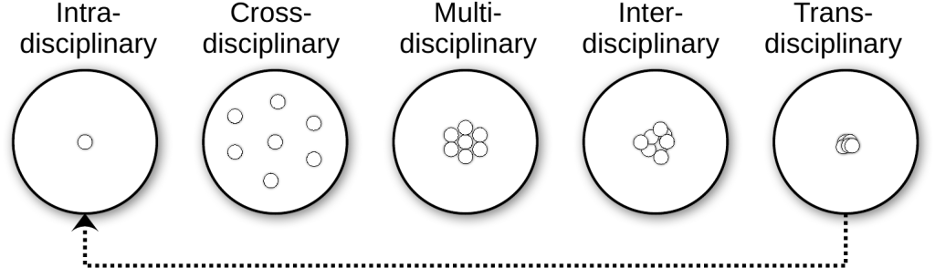
I quote the exact explanation of each term below, but give my own examples relevant to the COSSEE Lab.
Disciplinary traversals
Intradisciplinary: “Working within a single discipline”
Example: Two ecologists are working together to design and collect data examining the life history of the Blue Tit.
Crossdisciplinary: “Viewing one discipline from the perspective of another.”
Example: The ecologists recruit a statistician to consult, to ensure that the statistical model they select is optimal for their design.
Multidisciplinary: “Working together with people from different disciplines, each drawing on their disciplinary knowledge.”
Example: An evolutionary biologist forms a team with the ecologists and statistician, to examine how ecological conditions drive changes in the life history of the Blue Tit.
Interdisciplinary: “Integrating knowledge and methods from different disciplines, using a real synthesis of approaches.”
Example: Using knowledge gained from the team, they join forces with local historians with expertise in the local community’s interactions with the bird to create one unified approach to conservation efforts and a roadmap.
Transdisciplinary: “Creating a unity of intellectual frameworks beyond the disciplinary perspectives.”
Example: Based on the success of the conservation roadmap, the work grows into a transdisciplinary conservation effort.
There have been excellent visualizations of these concepts with other examples provided. Archontia Manolakelli offers both on a fantastic blog post. There has also been scholarly literature on working across these traversals, including work on transdisciplinary research (Harris et al., 2024), interdisciplinary teamwork (Nancarrow et al., 2013), and multidisciplinary approaches including generative AI across disciplines (Ooi et al., 2025). However, this is a blog post, and now that you are hopefully familiar with the different definitions of research across boundaries, we can move to the tips that I have found useful in my own disciplinary travels.
Tip 1: Figure out where you and your research are positioned in the continuum
The position of your research and yourself as a researcher will change over time. It will fluctuate across subprojects and different collaboration dynamics, or it might fit somewhere between two definitions. Questions that can help you reflect are:
- What disciplinary lens are you bringing to this blog post?
- What brought you to this COSSEE blog post: the lens of open science, or ecology and evolution?
Reflecting on such matters can be considered a kind of positionality, which is frequently discussed in qualitative research (Bourke, 2014).
Tip 2: Read widely, read what you’re interested in, and read what you don’t yet quite understand
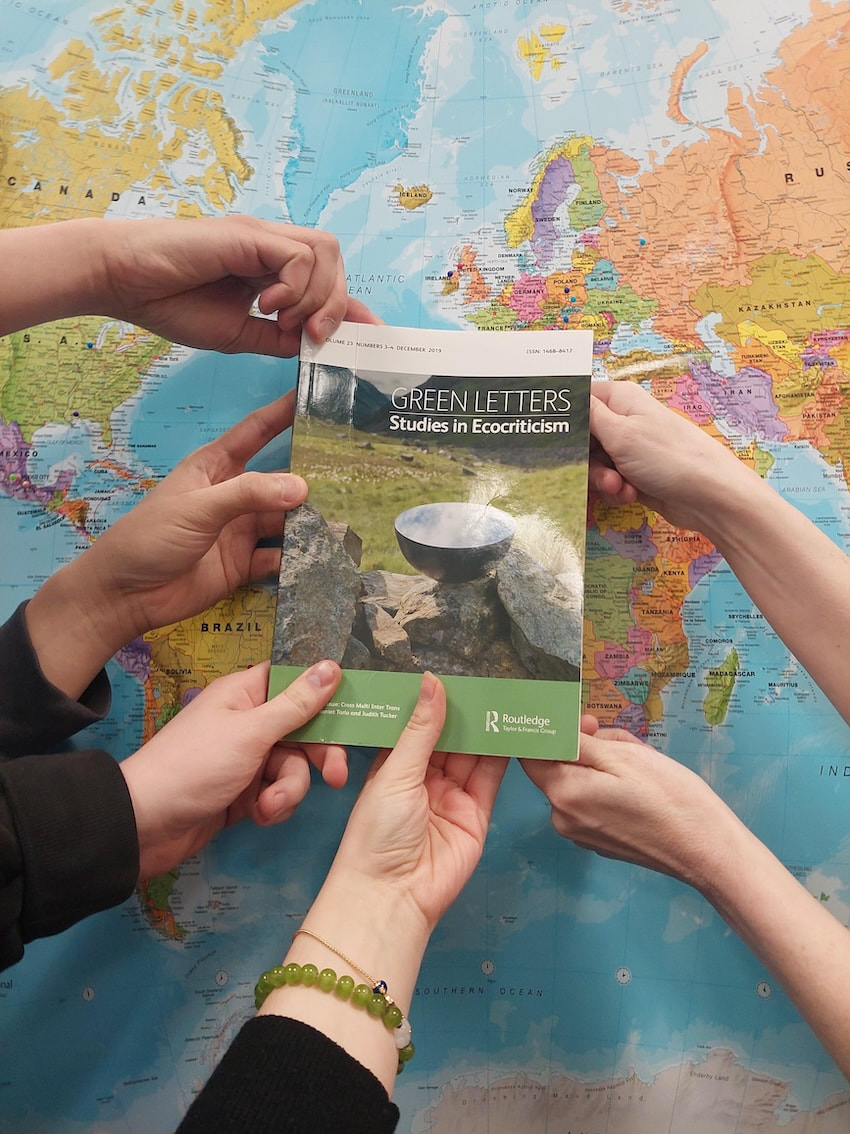
I originally encountered Stember’s definition (1991) of disciplinary boundaries through Tarlo and Tucker’s (2019) excellent introduction to an event bringing together academics and artists to explore disciplinary boundaries and “explore ideas around place, ecology and environment” (2019, p. 19) through a conference, exhibition, and manuscript. Yet the reason I read this text in the first place was because it appeared in the journal Green Letters, dedicated to studies of empirical ecocriticism, a field that brings together the humanities and ecology.
It was an interesting way of bridging the discipline of my last role in empirical literary studies and now biological sciences, as recommended by my former PI, Dr. Ailise Bulfin. I did not know it then, but it would become a foundational text for defining collaborations, which is a key part of my proposed PhD thesis.
Tip 3: Respect other disciplines, even if you don’t understand or feel interested in them
Speaking of reading things that may lie dormant in your mind until the right time, there will also be disciplines that do not interest you either professionally or personally. I will not disrespect any discipline by naming the ones I am apathetic to publicly, because for another scholar they are the source of passion, and passion is infectious.
It is important to respect other disciplines, as you may end up working with someone deeply rooted in them or carrying a history shaped by them.
Tip 4: Learn the language of different disciplines
Although all disciplines are connected to some degree in the pursuit of knowledge and truth, even fields using similar methodological frameworks often have different accents within the same language. For instance, although statistical models are used both in psychology and biology, there are stark differences in the designs they are applied to.
This becomes visible in the terminology: predictor versus independent variable for the effect of interest, and response versus dependent variable for what is being affected, respectively.
Tip 5: The sunk cost fallacy is just a fallacy
No knowledge is ever wasted or rendered obsolete. If you become an expert in something or advance your career in a certain field, you are not obligated to remain there. You can move away, and the knowledge will move with you and be transformed in new disciplines and new domains.
References
Bourke, B. (2014). Positionality: Reflecting on the research process. The Qualitative Report, 19(33), 1-9.
Harris, F., Lyon, F., Sioen, G. B., & Ebi, K. L. (2024). Working with the tensions of transdisciplinary research: A review and agenda for the future of knowledge co-production in the Anthropocene. Global Sustainability, 7, e13.
Jensenius, A. R. (2022). Sound actions: Conceptualizing musical instruments. MIT Press.
Nancarrow, S. A., Booth, A., Ariss, S., Smith, T., Enderby, P., & Roots, A. (2013). Ten principles of good interdisciplinary team work. Human Resources for Health, 11(1), 19.
Ooi, K. B., Tan, G. W. H., Al-Emran, M., Al-Sharafi, M. A., Capatina, A., Chakraborty, A., … & Wong, L. W. (2025). The potential of generative artificial intelligence across disciplines: Perspectives and future directions. Journal of Computer Information Systems, 65(1), 76-107.
Tarlo, H., & Tucker, J. (2019). Cross Multi Inter Trans: A contextual introduction. Green Letters, 23(3), 219-230. https://doi.org/10.1080/14688417.2019.1682347